It may seem incongruous to our contemporary minds that a major vineyard could exist in the Parisian region. While Paris is famous today for its café culture, the city and its surrounding region were once among the most prosperous wine-producing areas in France.
The Power of the Abbeys
The Parisian vineyard is as old as the city itself, with traces dating back to the Roman era. The Emperor Julian, who stayed in Lutetia (the Roman name of Paris), described slopes like Montagne Sainte-Geneviève covered in vines, and giving “good wines”.
During the Medieval times, powerful religious institutions led the industry. The Abbey of Saint-Denis was a giant, owning land in Charonne, Belleville, and Montmartre, while the Abbey of Saint-Germain-des-Prés was famously established in Suresnes, where the wines were highly reputed. The grapes were originally whites, and “paillets / clairets” (light reds) and overall quite light.
By 1820, the territory of the Seine and Seine-et-Oise departments boasted no fewer than 27,000 hectares of vines. This was a massive industry where 223 out of 348 communes of the departments possessed more than five hectares of vineyards. This heritage remains etched in the city’s geography through names like “rue des Vignes” (Vineyard street) or “rue du Pressoir” (Press street), and the presence of chestnut forests in the region, which were originally grown to produce the “échalas”(the wooden stakes used to support the vines).
The fall of the Parisian vineyards
The decline of the Parisian vineyard was not a single event, but rather the result of powerful forces converging in the 19th century.
The climate in Paris has always been a challenge for viticulture, characterized by unpredictable frosts and high humidity. Wine was produced mostly out of necessity (mass, hydratation), and the quality was not the most important factor. The vineyards were frequently wiped out by extreme winters and diseases, meaning Paris never had old vines because they constantly had to be replanted.
The development of the French rail network in the mid-19th century didn’t help. The train allowed for the massive and rapid transport of wines from the South of France, which benefited from a superior climate and lower production costs, and often much better than the local Parisian production.
Unlike other regions that turned their wine into a luxury product, Paris remained stuck producing ordinary wine, making its disappearance inevitable once better alternatives became available. The city’s terroir was simply not adapted to producing Grands Crus, like Champagne or Bordeaux who spent centuries refining their techniques and protecting their reputations.
Safer than the Seine river
If vineyards once covered the Parisian hillsides, it was also because wine played a vital role in the daily lives of its inhabitants. Indeed, water has not always been as safe or accessible as it is today. Historically, Parisian wells and the Seine river were frequently contaminated. Because of the fermentation process, alcoholic beverages like wine or beer were often a safer and more reliable source of hydration than untreated water. However, it is a misconception that water was avoided entirely, people still drank it out of necessity or when fresh sources were available. It is also important to remember that the daily alcoholic beverages of the time were typically much lighter than they are today.
This cultural preference was so deeply entrenched that in the capital and across France, children were often served light wine in schools to “strengthen” them. It wasn’t until 1956 that the French government officially banned alcohol for children under 14 in schools, a ban that was only extended to all secondary students in 1981.”
The surviving vineyards of Paris
While the ancient vineyards largely vanished, the six sites below, listed in order of their replanting date, serve as modern tributes.
With the exception of Montmartre, which was replanted in 1932, these were all recently replanted in the late 20th century or even more recently !
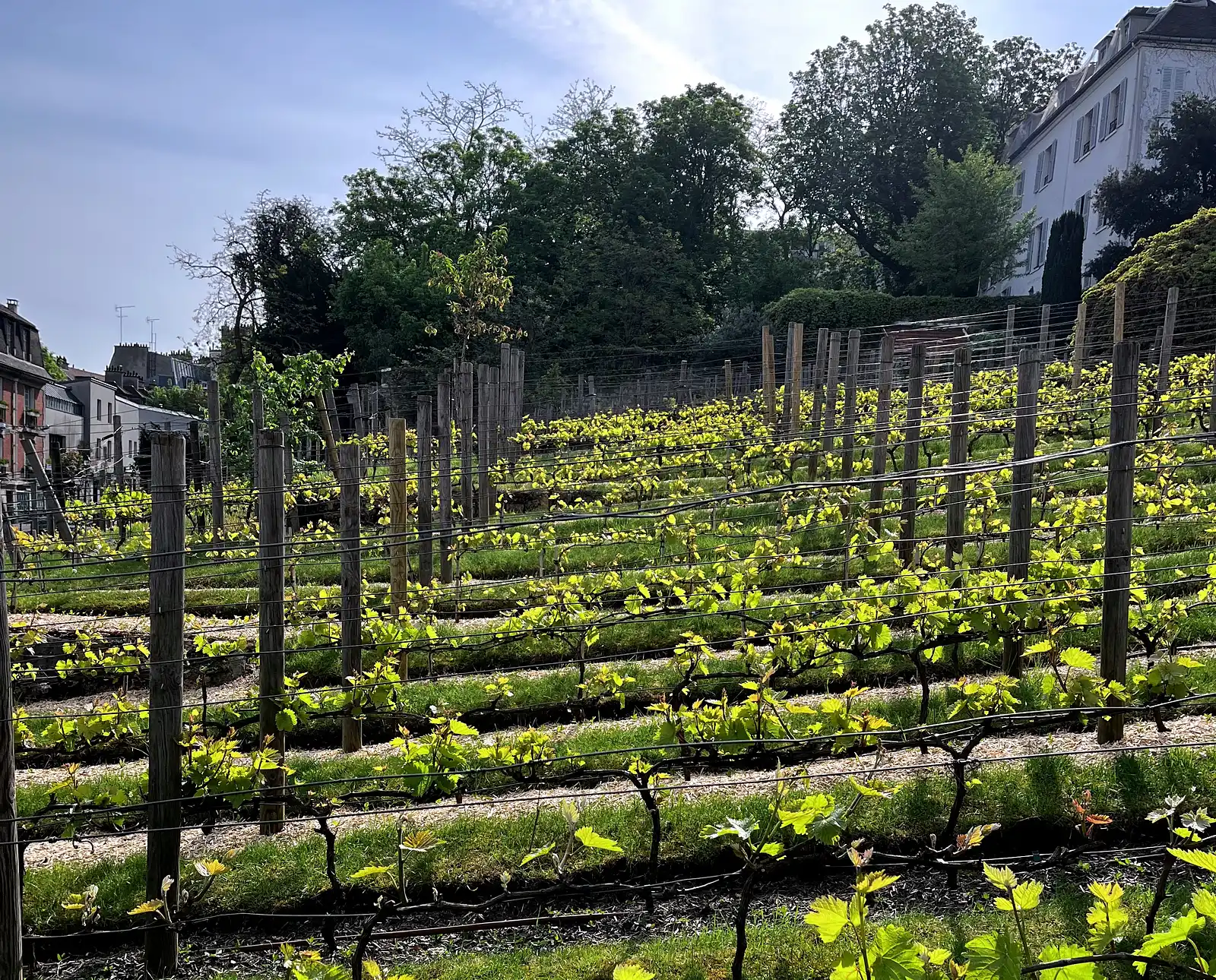
1. Clos de Montmartre (18th Arr.)
The most famous of them all, these vines are the oldest in the capital.
Historically owned by the Abbey of Saint-Denis, the original vineyards disappeared in the 18th century due to urban development, the current site was replanted in 1932 to protect the land from developers. It produces about one ton of grapes a year, leading to nearly 2 000 bottles of red and rosé annually, vinified in the cellars of the 18th arrondissement town hall.
Each year, the vintage is named after a local icon, such as Dalida or the Lapin Agile !

2. Parc Georges Brassens (15th)
In the 15th arrondissement, the Clos des Morillons is a tribute to the southern slope of the old Vaugirard hamlet. By the end of the 18th century, vegetables had replaced the grapes, but the city brought the vines back in 1983.
Its 720 vines produce around 300 bottles a year, sold at auction for charity.
3. Parc de Belleville (20th)
Back in the Parc de Belleville since 1992, these 190 vines sit on land once known as Savies. In the 13th century, monks cultivated 15 hectares here. This is where the “Piquette” was born, originally a young, sparkling wine, though the word now refers to cheap vinegar!
It also gave us the term “Guinguet”, which led to the famous guinguettes.
4. Butte Bergeyre (19th)
Perched at an altitude of 100 meters in the 19th arrondissement, the Clos des Chaufourniers is the most confidential vineyard in Paris. Hidden from the crowds and offering a stunning view of the Sacré-Cœur, it isn’t even open to the public for safety reasons.
Legend has it that a city gardener planted the first vine here in 1995 just to see what would happen. It went quite well, as the first harvest happened in 2010 !
5. Parc de Bercy (12th)
Before it was a park, Bercy was once the largest wine and spirits market in the world. Located outside the city tax walls and right on the Seine, it was the perfect logistics hub for barrels arriving by boat. You can still see the old rails and stone paths used to roll the barrels today.
Replanted in 1996, the vineyard now uses disease-resistant varieties, and produces about 100 liters of wine annually
6. Clos des Arènes de Lutèce (5th)
Between the 14th and 18th centuries, this area provided Parisians with high-quality grapes for over 400 years.
Planted in 2021 around the ancient Gallo-Roman amphitheater, these 200 vines mark a return to the site's history. Today, the association in charge maintains the slope according to strict environmental charters.

And that’s it for this article ! Let me know if you were lucky to have a sip of some of these Parisian wines. And if you have subjects in mind that you would be interested in reading, leave a comment. Cheers !
To go further :