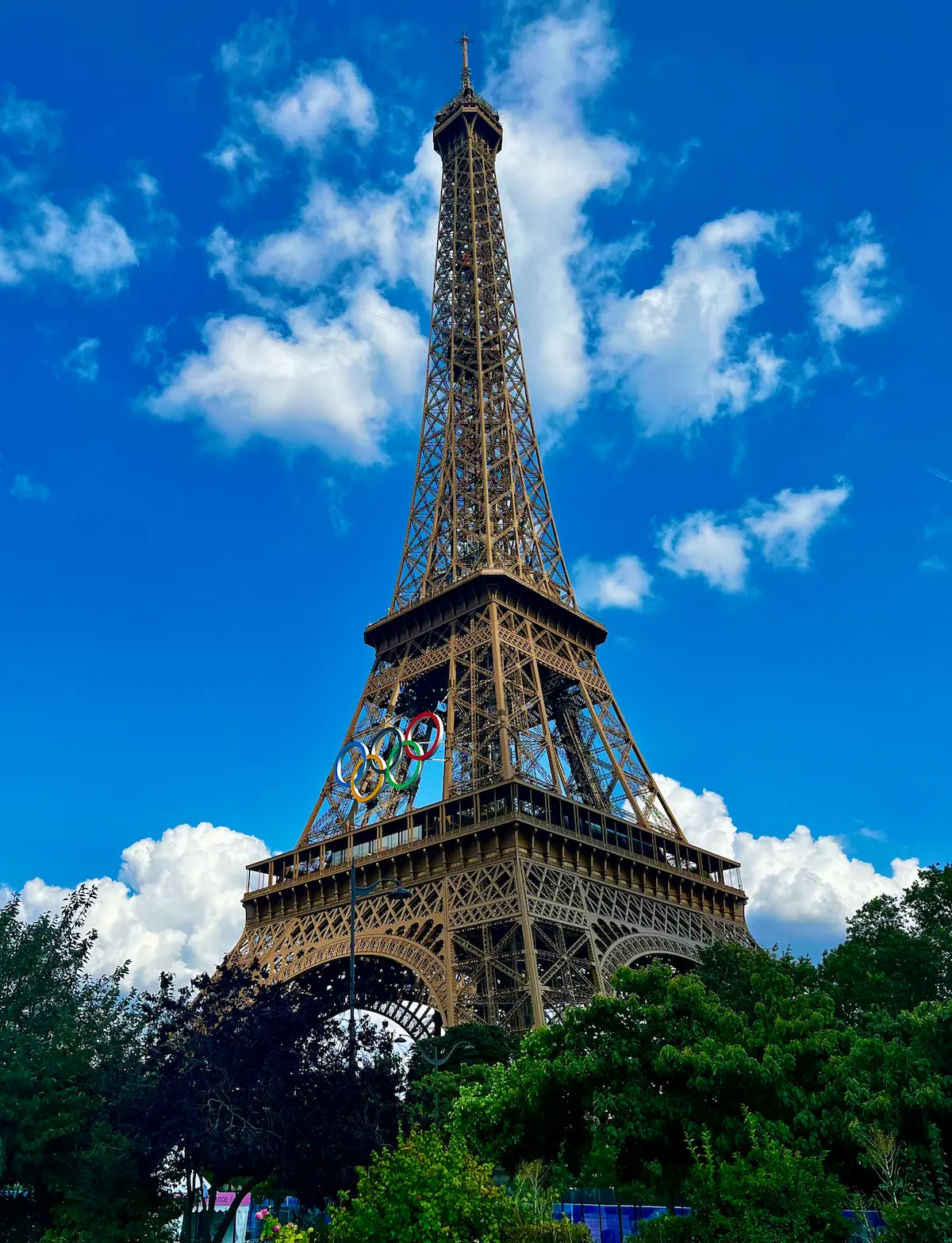
The Tour Eiffel was built in 1889 for the Universal Exhibition celebrating the centenary of the French Revolution. Gustave Eiffel had two years to raise it, and it was meant to be temporary, scheduled for demolition twenty years after the exhibition closed. The reason it still stands is that it proved useful as a radio transmission tower, a fact that saved it in 1909 and saved it again during the First World War, when it jammed German communications.
What most visitors miss, standing beneath it or photographing it from the Trocadéro, is the engineering. The tower is seven thousand three hundred tonnes of wrought iron, assembled from eighteen thousand individual parts by three hundred workers in twenty-six months. On the hottest summer day the top sways no more than twelve centimetres in the wind. Understanding what Eiffel actually built changes the way you see it.
What you will see
The structure and its story. We begin on the ground, with the tower seen from below, where the engineering is most legible. How it was designed and calculated, why Eiffel's structural innovations mattered as much as the tower's scale, and what France was trying to say to the world in 1889, on the centenary of the Revolution. We tell the story of the controversy too, the petition signed by three hundred artists and intellectuals against the project, and what it reveals about a city that has always argued about its own image.
The ascent and the view. Higher up, the first floor with its glass floor and the original hydraulic lift mechanism still in place, and the small apartment Gustave Eiffel kept for himself near the summit and refused to rent to anyone. From above, Paris is laid out and made legible, the river, the great axes, the arrondissements spiralling outward from the Île de la Cité.
The engineering · the controversy · the view from the summit
Pépin's advice
Begin on the ground. The tour starts at the foot of the tower, with the structure seen from below, before going up. The engineering is most visible at close range, and the walk along the Champ de Mars sets it in scale.
Go early, or go at dusk. The tower at nine in the morning, when the Champ de Mars is still empty, is a different place from the tower at two in the afternoon. At dusk the light on the ironwork is specific and worth the timing.
Book the summit in advance. Access to the upper levels depends on timed tickets that sell out weeks ahead in high season. This is arranged for you at booking.
Good to know
The summit is reached by lift and can close at short notice in high wind, which is beyond anyone's control. When that happens we reshape the visit around the lower levels and the ground, where most of the engineering is in any case best seen. A private guide can adapt the route on the spot in a way a fixed group tour never could.